A UNIX Command
$tee name
my name is nice.
my name is nice.
$cat name
my name is nice.
$
UNIX Explanation
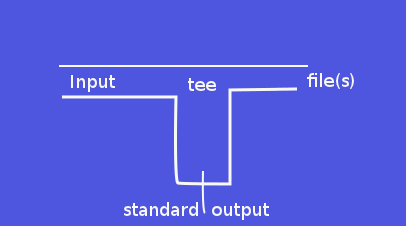
Copy standard  input to each  FILE, and also  to standard
output.  A  special variant of  the tee for the  shell is
called script and  permits duplicating all input commands
submitted to a shell into a file.
Related Source Code Exposition
static bool

tee_files (int nfiles, const char **files)

{

  FILE **descriptors;

  char buffer[BUFSIZ];

  ssize_t bytes_read;

  int i;

  bool ok = true;

  char const *mode_string =

    (O_BINARY

     ? (append ? "ab" : "wb")

     : (append ? "a" : "w"));
descriptors = xnmalloc (nfiles + 1, sizeof *descriptors);
/* Move all the names `up' one in the argv array to make room for
the entry for standard output. This writes into argv[argc]. */
for (i = nfiles; i >= 1; i--)
files[i] = files[i - 1];
if (O_BINARY && ! isatty (STDIN_FILENO))
xfreopen (NULL, "rb", stdin);
if (O_BINARY && ! isatty (STDOUT_FILENO))
xfreopen (NULL, "wb", stdout);
/* In the array of NFILES + 1 descriptors, make
the first one correspond to standard output. */
descriptors[0] = stdout;
files[0] = _("standard output");
setvbuf (stdout, NULL, _IONBF, 0);
for (i = 1; i <= nfiles; i++)
{
descriptors[i] = (STREQ (files[i], "-")
? stdout
: fopen (files[i], mode_string));
if (descriptors[i] == NULL)
{
error (0, errno, "%s", files[i]);
ok = false;
}
else
setvbuf (descriptors[i], NULL, _IONBF, 0);
}
while (1)
{
bytes_read = read (0, buffer, sizeof buffer);
#ifdef EINTR
if (bytes_read < 0 && errno == EINTR)
continue;
#endif
if (bytes_read <= 0)
break;
/* Write to all NFILES + 1 descriptors.
Standard output is the first one. */
for (i = 0; i <= nfiles; i++)
if (descriptors[i]
&& fwrite (buffer, bytes_read, 1, descriptors[i]) != 1)
{
error (0, errno, "%s", files[i]);
descriptors[i] = NULL;
ok = false;
}
}
if (bytes_read == -1)
{
error (0, errno, _("read error"));
ok = false;
}
/* Close the files, but not standard output. */
for (i = 1; i <= nfiles; i++)
if (!STREQ (files[i], "-")
&& descriptors[i] && fclose (descriptors[i]) != 0)
{
error (0, errno, "%s", files[i]);
ok = false;
}
free (descriptors);
return ok;
}
Source Code Highlight
Copy the standard input into  each of the NFILES files in
FILES  and  into the  standard  output.   Return true  if
successful.
Featured Image
Related Knowledge
The  `tee'  command  copies  standard input  to  standard
output and also to any files given as arguments.  This is
useful when  you want not only  to send some  data down a
pipe, but also to save a copy.